Sunset at the horizon.
This was something else entirely: a quality of presence, of being genuinely with myself rather than merely by myself.
Title: The Gathering
Artist Statement

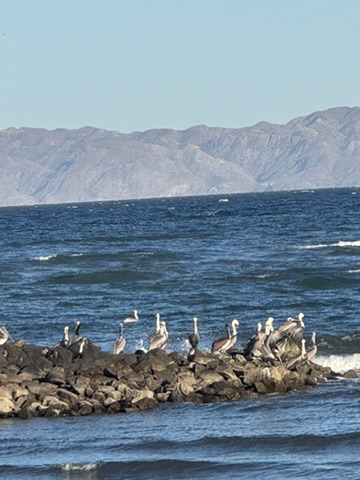
They gathered where the land gives way to water.

Perched along the rocks, they faced different directions, yet remained part of the same quiet formation. No urgency. No competition for space. Just bodies arranged along the shoreline, each holding its own stillness while sharing the same horizon.

I stood at a distance watching them.

What struck me was their patience. The way they waited without signalling waiting. The way they scanned the water without appearing restless. There was a rhythm to their presence that felt familiar to me, a kind of learned stillness that comes from spending long periods observing rather than intervening.

In that moment, I recognised something of my own practice reflected back.

This work of standing at edges. Of watching what moves beneath the surface. Of trusting that some moments ask only to be witnessed. Some moments ask only for attention. For steadiness. For remaining long enough that the landscape forgets you are there.

The mountains behind them held their own quiet authority, grounding the scene in time beyond the immediate. Water, rock, wing, distance. Each element coexisting without demand.

I kept my distance.

I allowed the distance to remain intact, understanding that proximity rarely determines connection. Sometimes respect lives in observation alone.

Photo Credit Amy Tucker, January 2026
References
Google. (n.d.). Google Translate. https://translate.google.com
The evening I arrived in Loreto, Mexico, I stood on the malecón watching pelicans dive into the Sea of Cortez, and I felt something without a name.
Some moments ask only for attention.
It was something beyond loneliness, though I was profoundly alone, 3,000 kilometres from home, knowing no one, with thirty days of solitude stretching before me. Neither was it the comfortable solitude I had glimpsed in rare moments throughout my life, those brief pauses between obligations when I might read undisturbed or walk without destination.
I had no words for this experience. During Covid, I learned to call this place alonetude.
For decades, psychological research has approached solitude primarily through a deficit lens, and rightly so. Social isolation carries mortality risks equivalent to smoking fifteen cigarettes daily. Loneliness predicts cardiovascular disease, cognitive decline, and depression. The public health imperative to address what former U.S. Surgeon General Vivek Murthy called an “epidemic of loneliness” has produced essential knowledge and helped countless people.
But this focus created a gap. By treating solitude primarily as the absence of connection, we overlooked solitude as presence: the presence of self, meaning, and restoration that becomes available when social demands recede.
Alonetude requires four elements working together like legs of a table:
Intentional choice: Solitude must be chosen, never imposed. Research shows that autonomous motivation predicts positive outcomes regardless of introversion.
Felt safety: The nervous system must register it as safe. You cannot think your way into alonetude while your body scans for threat.
Present-moment awareness: Beyond rumination or distraction, genuine presence, what emerges when attention settles.
Meaning integration: Connection to values, purpose, or something larger than the passing moment.
Remove any one element, and the table collapses. Strength in one cannot compensate for the absence of another. This is the threshold model at the heart of the framework.
The Sea of Cortez cares nothing about whether humans theorise about solitude. The pelicans dive and surface following rhythms older than language. The mountains turn rose and gold at sunset regardless of who watches. But for those willing to participate, genuinely, patiently, with bodies regulated and hearts open, something becomes available. Presence to life, rather than escape from it. Presence of self, rather than absence of others.
Beyond loneliness and beyond mere solitude, something for which I needed a new word.
That word is alonetude. I offer it now as an invitation.
Presence to life, rather than escape from it.
Title: Welcome to Loreto
Artist Statement

My arrival was anything but quiet.

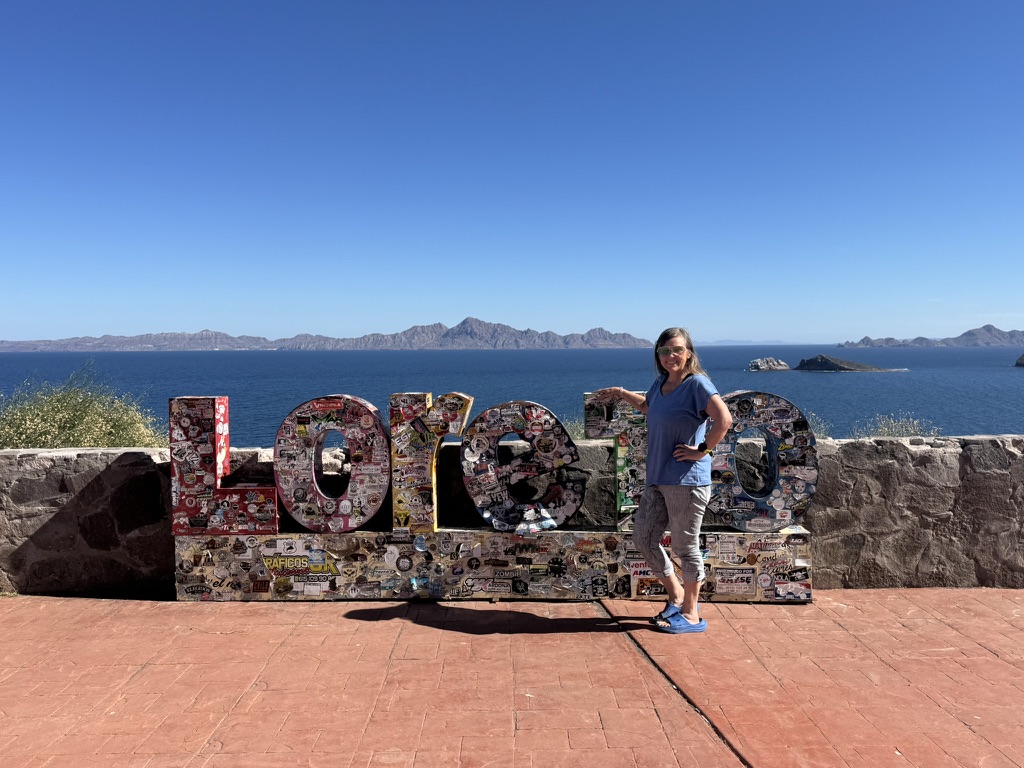
The letters announced it before I could. Large, textured, impossible to ignore. Covered in stickers layered over time, each one evidence that others had stood here too, marking their presence in colour and adhesive and memory. I stepped into the frame, aware that this was a different kind of shoreline moment than the solitary ones.

This was a public threshold.

Behind me, the Sea of Cortez stretched wide and steady, holding its own depth regardless of the spectacle in front of it. Mountains sat low along the horizon, grounding the scene in geological time while the foreground pulsed with tourism, movement, and human imprint. The contrast was immediate. Vastness behind. Declaration in front.


Traveller. Researcher. Body in place. Name unspoken yet presence visible. Unlike the quieter images, this one carries performance within it. Beyond the institutional sense of performance, simply acknowledging that sometimes presence is witnessed, documented, shared. That being in a place can hold both interior meaning and outward expression.

I left soon after the photograph.

I stepped away from the letters and back toward the waterline, where scale shifts again and the body becomes smaller against land and sea. Yet the image remains important because it marks arrival in a way solitude cannot do alone.

A pause between anonymity and recognition.
Between landscape and inscription.
Between being there and being seen.

Photo Credit Amy Tucker, January 2026
I am still here.
Note. Spanish-language passages were generated using Google Translate (Google, n.d.) and subsequently reviewed and refined by the author. Any remaining infelicities reflect the limits of machine translation rather than intent.