For much of my adult life, I believed that being alone was something to manage rather than something to understand. Like many people shaped by caregiving roles, professional responsibility, and constant availability, I learned to associate aloneness with either failure or escape. To be alone for too long was suspect. To seek it deliberately required justification.
Keywords: alonetude, loneliness, solitude, third way, being alone, human rights, rest, scholarly personal narrative, embodied knowing
Title: The Threshold
Artist Statement

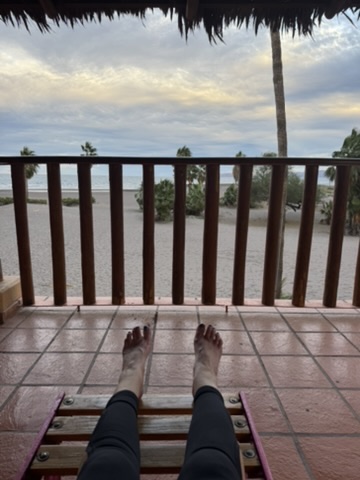
This image sits quietly at the intersection between arrival and release.

The body is positioned in rest, still partway toward surrender. Legs extended, feet bare, the posture signals pause rather than sleep. I am neither moving nor working. I am simply placed. The wooden railing forms a horizontal boundary across the frame, a subtle reminder of enclosure, of protection, of holding. Beyond it, the landscape opens without demand. Sand. Palms. Sea. Sky.

What strikes me most is how unfamiliar this posture felt when I first entered it. Rest, after prolonged precarity, comes with difficulty. The body takes time to trust stillness. Even here, overlooking water, there is a period of adjustment where the nervous system scans for urgency that is no longer present.

Within the Alonetude inquiry, this photograph documents the early stages of relearning safety. Polyvagal theory reminds us that the body must perceive safety before it can inhabit rest. The environment offers cues: horizon line, open air, diffused light, the absence of surveillance or expectation. Slowly, the breath lengthens. The shoulders release. The feet, unguarded, extend into space.

There is also something important about perspective. The image is taken from the body rather than of the body. This matters methodologically. It situates the viewer within the experience rather than outside it. This is inhabitation rather than observation.

Rest, here, is recalibration.

The threshold is the body learning it no longer has to brace.

Description

A first-person view from a shaded balcony. Bare feet extend toward a wooden railing overlooking sand, palm trees, and the sea under a soft, clouded sky. The composition centres stillness, horizon, and embodied perspective.

Photo Credit: Amy Tucker, January 2026
This tension has only intensified in recent years. Public discourse now frames loneliness as a public health crisis, with good reason. A growing body of research links chronic loneliness to increased risk of depression, cardiovascular illness, cognitive decline, and early mortality (Cacioppo & Cacioppo, 2018; Holt-Lunstad et al., 2015). Indeed, a meta-analysis of 148 studies involving more than 300,000 participants found that stronger social relationships were associated with a 50% higher likelihood of survival (Holt-Lunstad et al., 2010).
Yet alongside this concern runs another, quieter exhaustion: many people feel overwhelmed by constant connection, by the expectation of perpetual responsiveness, and by the emotional labour of being continually available.
We are caught between two unsatisfying stories about being alone.
On one side lies loneliness, understood as a painful, unwanted disconnection. In contrast lies romanticised solitude, idealised as a rarefied retreat available only to those with time, money, or particular personality traits. During my research and lived inquiry, I came to believe that this binary is incomplete. There is a third way of being alone that is neither deprivation nor escape. I call this way alonetude.
Defining Alonetude
Alonetude is a cultivated, sustainable relationship with one’s own company. It is the capacity to be peacefully and intentionally alone without collapsing into loneliness or relying on fantasy versions of solitude. Alonetude represents a way of being, beyond any particular place or retreat.
Unlike solitude, which is a neutral description of physical aloneness, alonetude refers to an inner condition. One can be physically alone without experiencing alonetude, and one can experience alonetude in the presence of others. It is defined by relationship rather than isolation: specifically, the relationship one has with oneself. Recent qualitative research confirms that both laypeople and researchers distinguish between objective solitude (physical separation from others) and subjective solitude (mental disengagement from social demands), with the latter possible even in public spaces (Weinstein et al., 2023a).
This distinction matters because much of the harm associated with being alone arises from the meanings we attach to it rather than from aloneness itself. Loneliness, as defined in the literature, is the subjective distress that results from a perceived gap between desired and actual connection (Perlman & Peplau, 1981). Solitude, by contrast, describes the absence of immediate social contact. Aloneness refers to what can arise when solitude is approached with choice, care, and presence.
Choice, Autonomy, and the Conditions for Alonetude
Title: Witness on the Edge
Artist Statement

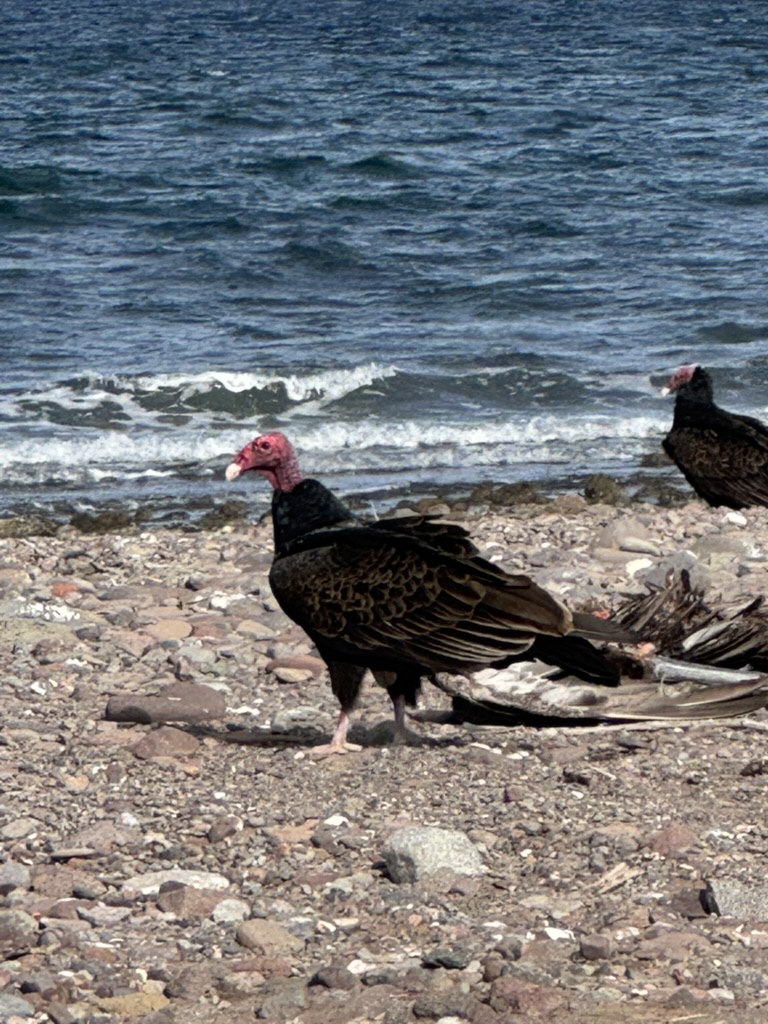
They were already there when I arrived.

Standing at the shoreline, unbothered by my presence, as if I had entered their space rather than the other way around. The water moved in its steady rhythm behind them, small waves folding themselves onto the rocky beach. Nothing dramatic. Just repetition. Breath-like.

What struck me first was their stillness.

The absence of urgency rather than movement. They stood in a way that felt deliberate, almost ceremonial. One closer to me. One slightly behind. A quiet companionship beyond the need for interaction.

There is something about vultures that unsettles people. We are taught to read them as symbols of decay, of endings, of what is left behind. Yet standing there, watching them, I felt recognition rather than fear or discomfort.

I felt recognition.

They are cleaners of landscapes. Carriers of ecological responsibility. They arrive where others turn away. They do necessary work without spectacle.

In that way, they felt less like ominous figures and more like witnesses. Keepers of threshold spaces. Present where land, water, and mortality meet.

The shoreline itself felt like a liminal zone that morning. Caught between ocean and land. A place of arrival and departure. Of what washes in and what is taken back out.

Seeing them there, grounded and unhurried, I felt reminded that presence can exist without performance. Some forms of being are observational. Attentive. Essential without needing to be visible in celebratory ways.

I stayed where I was.

I let the distance remain. A respectful space between species, between roles. I watched. They watched. And the water continued its steady conversation with the shore.

Less symbolism. More coexistence.


Photo Credit Amy Tucker, January 2026
One of the most consistent findings in psychological research is that the quality of time spent alone depends less on personality and more on motivation. Research grounded in Self-Determination Theory demonstrates that solitude supports well-being when it is volitional and values-aligned, and undermines well-being when it is imposed or avoidant (Ryan & Deci, 2017; Nguyen et al., 2018). A 21-day diary study of 178 adults found that the detrimental effects of solitude on loneliness and life satisfaction were nullified or reduced when daily solitude was autonomous, that is, chosen rather than imposed (Weinstein et al., 2023b).
This insight reshaped my own assumptions. I had long believed that comfort with being alone was a matter of introversion. The research suggests otherwise. Three experimental studies by Nguyen et al. (2018) found that autonomous motivation for solitude predicted positive outcomes regardless of participants’ introversion levels. When people choose solitude for reasons such as restoration, reflection, or creativity, they tend to experience greater emotional regulation and clarity. When solitude is driven by fear, exclusion, or obligation, it often intensifies distress.
Alonetude emerges under conditions of autonomy. It arrives through allowance rather than force; one chooses to remain present with oneself rather than immediately seeking distraction or validation.
The Body’s Role in Being Alone Well
Another central insight from my research is that alonetude is, first and foremost, a physiological achievement.
Polyvagal Theory offers a helpful lens here. According to this framework, the autonomic nervous system continuously scans for cues of safety or threat through a process called neuroception, the detection that occurs below conscious awareness and shapes emotional and relational capacity (Porges, 2011). When the body perceives a threat, the sympathetic nervous system mobilises the fight-or-flight response, and being alone can feel agitating or unbearable.
When the body experiences safety through activation of the ventral vagal pathway, quiet becomes accessible.
This distinction explains why simply telling oneself that solitude is “good” rarely works. Felt safety cannot be reasoned into existence. It is established through rhythm, gentleness, predictability, and sensory cues that the body recognises as regulating. Only when the nervous system settles does reflective capacity return.
In this sense, alonetude is an embodied practice. It develops through repeated experiences of staying present long enough for the body to register safety, rather than through insight alone.
Alonetude and Relational Capacity
A common concern is that time alone weakens social bonds. My findings suggest the opposite. When individuals cultivate a stable, companionable relationship with themselves, they often return to others with greater attentiveness and emotional availability.
This aligns with research suggesting that positive solitude correlates with enhanced intimacy rather than diminished connection (Long & Averill, 2003). In their foundational exploration of solitude’s benefits, Long and Averill identified intimacy as one of four key benefits, alongside freedom, creativity, and spirituality, and noted that time alone can deepen rather than diminish our capacity for closeness. The relational ethicists Carol Gilligan (1982) and Nel Noddings (1984) similarly argue that secure self-connection supports healthier interpersonal engagement. Alonetude strengthens what I describe as relational capacity: the ability to engage with others without losing oneself, over-functioning, or seeking constant reassurance.
From this perspective, alonetude prepares the ground for connection rather than competing with it.
Loneliness as Visitor, as Teacher
Alonetude holds loneliness alongside itself. Even within chosen solitude, moments of missing others still arise. The difference lies in how these moments are met.
When loneliness is approached with presence rather than avoidance, it often reveals itself as evidence of attachment and care rather than deficiency. It signals what matters. Research on emotion regulation supports this approach, suggesting that allowing emotional states to be experienced without immediate suppression supports long-term well-being (Gross, 2015). Attempts to suppress or avoid emotions are counterproductive, whereas acceptance and reappraisal facilitate adaptive processing.
In this sense, loneliness is part of the terrain one learns to walk with steadiness.
Alonetude as a Gentle Discipline
Developing alonetude requires what I call the discipline of staying. This is discipline as faithfulness rather than rigidity or endurance, but discipline as devotion. It is the repeated choice to remain present with oneself rather than immediately filling silence or discomfort.
This practice echoes contemplative traditions while remaining accessible in everyday life. Alonetude is cultivated through small, consistent acts of attention: staying with a morning cup of tea, allowing quiet to stretch a little longer, noticing the impulse to distract and choosing to pause instead.
Over time, these practices create an inner refuge that can be carried into the noise of daily life.
Coming Home to Oneself
Alonetude is a relationship developed over time rather than a destination reached once. It allows a person to move through the world without constant self-abandonment, to be with others without depletion, and to return to oneself as a place of steadiness.
As I continue to write and research in this area, I find myself returning to a simple question that now guides much of my work:
What if home is a relationship we learn to inhabit within ourselves?
Title: What We See
Artist Statement

I almost missed it.

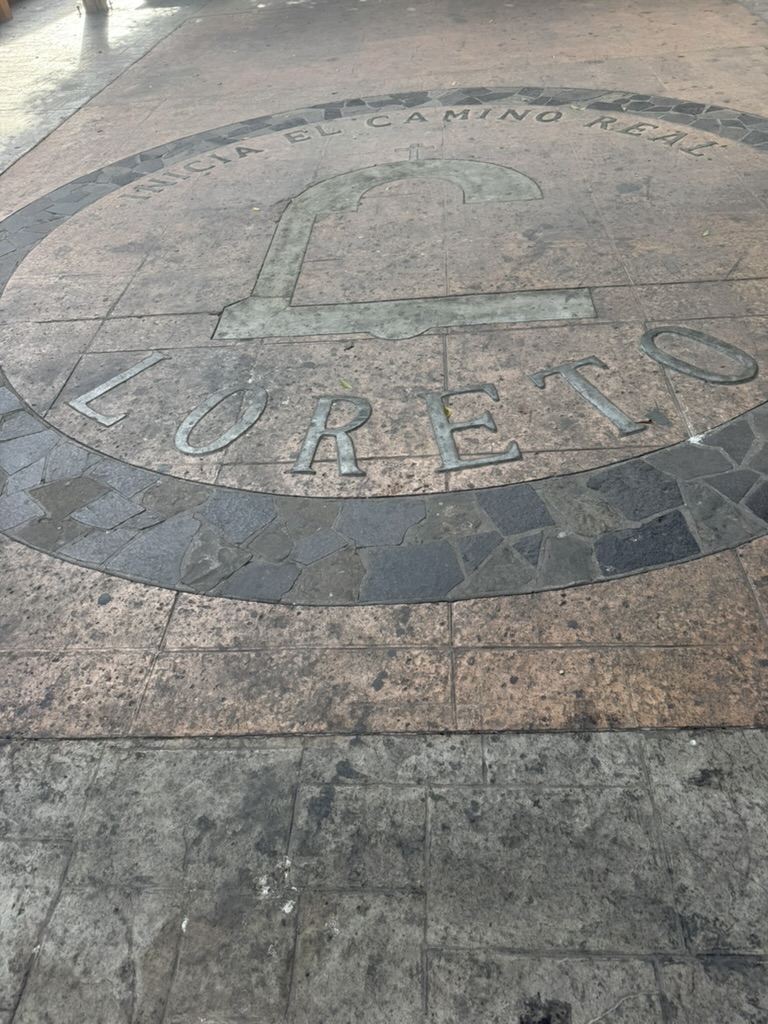
Simply because it was underfoot. Embedded into the ground in a way that asked for attention without demanding it. A circular marker, worn slightly by footsteps, weather, and time.

“Hacia el Camino Real. Loreto.”

Toward the Royal Road.

Standing there, I felt the quiet gravity of direction. Orientation rather than movement or departure. A reminder that paths existed long before I arrived and will continue long after I leave.

There is something humbling about markers placed in the earth rather than raised above it. They require you to look down. To lower your gaze. To acknowledge place before progress.

The stone held history without narration. No explanation panels. No instructions. Just an invitation to consider where you are standing and what routes extend outward from that point.

I stayed within the circle that day.

Instead, I stood within the circle for a few moments, noticing the textures beneath my feet. The worn edges of the lettering. The way the morning light caught the surface unevenly.

It felt less like a tourist marker and more like a threshold.

A place that holds both arrival and continuation. A reminder that every journey includes pauses of orientation. Moments where the body registers location before choosing direction.

Less about destination.

More about standing where the path begins.

Photo Credit Amy Tucker, January 2026
References
Cacioppo, J. T., & Cacioppo, S. (2018). The growing problem of loneliness. The Lancet, 391(10119), 426. https://doi.org/10.1016/S0140-6736(18)30142-9
Gilligan, C. (1982). In a different voice: Psychological theory and women’s development. Harvard University Press.
Gross, J. J. (2015). Emotion regulation: Current status and future prospects. Psychological Inquiry, 26(1), 1–26. https://doi.org/10.1080/1047840X.2014.940781
Google. (n.d.). Google Translate. https://translate.google.com
Holt-Lunstad, J., Smith, T. B., Baker, M., Harris, T., & Stephenson, D. (2015). Loneliness and social isolation as risk factors for mortality: A meta-analytic review. Perspectives on Psychological Science, 10(2), 227–237. https://doi.org/10.1177/1745691614568352
Holt-Lunstad, J., Smith, T. B., & Layton, J. B. (2010). Social relationships and mortality risk: A meta-analytic review. PLOS Medicine, 7(7), Article e1000316. https://doi.org/10.1371/journal.pmed.1000316
Long, C. R., & Averill, J. R. (2003). Solitude: An exploration of the benefits of being alone. Journal for the Theory of Social Behaviour, 33(1), 21–44. https://doi.org/10.1111/1468-5914.00204
Nguyen, T. T., Ryan, R. M., & Deci, E. L. (2018). Solitude as an approach to affective self-regulation. Personality and Social Psychology Bulletin, 44(1), 92–106. https://doi.org/10.1177/0146167217733073
Noddings, N. (1984). Caring: A feminine approach to ethics and moral education. University of California Press.
Perlman, D., & Peplau, L. A. (1981). Toward a social psychology of loneliness. In S. Duck & R. Gilmour (Eds.), Personal relationships 3: Personal relationships in disorder (pp. 31–56). Academic Press.
Porges, S. W. (2011). The polyvagal theory: Neurophysiological foundations of emotions, attachment, communication, and self-regulation. W. W. Norton.
Ryan, R. M., & Deci, E. L. (2017). Self-determination theory: Basic psychological needs in motivation, development, and wellness. Guilford Press.
Weinstein, N., Hansen, H., & Nguyen, T.-V. (2023a). Definitions of solitude in everyday life. Personality and Social Psychology Bulletin, 49(8), 1185–1200. https://doi.org/10.1177/01461672221115941
Weinstein, N., Vuorre, M., Adams, M., & Nguyen, T.-V. (2023b). Balance between solitude and socialising: Everyday solitude time both benefits and harms well-being. Scientific Reports, 13, Article 21160. https://doi.org/10.1038/s41598-023-44507-7
Note. Spanish-language passages were generated using Google Translate (Google, n.d.) and subsequently reviewed and refined by the author. Any remaining infelicities reflect the limits of machine translation rather than intent.