The research site is my own body. The methodology is presence.
A Deliberate Period of Research on Myself
What I Am Doing Here
I am sitting with my notebook, trying to articulate what this month is actually for. People keep asking. Are you on vacation? Are you writing a book? Are you running away from something?
The honest answer is: I am still finding the words. I know what I am leaving behind. I am leaving behind vacation in the way the word usually implies, with itineraries, tourist attractions, and the pressure to relax on schedule. I am beyond the wellness-industry retreat, where someone else structures my healing and tells me when to breathe deeply. I am running toward something, though I understand why the departure might look like a flight from the outside.
What I am doing is harder to name. I am conducting research. But the research site is my own body. The methodology is present. The data is whatever surfaces when I stop performing productivity long enough to notice what I actually feel.
This is what Scholarly Personal Narrative makes possible. Education scholar Robert Nash (2004) writes that “scholarly personal narrative writing is the unabashed, up-front admission that your own life signifies” (p. 24). My life signifies. My exhaustion signifies. My body, with its accumulated tensions and its slow-releasing grief, signifies. These belong to the research itself.
“For years, I have leapt out of bed with adrenaline already coursing, my mind racing through the day’s obligations before my feet touched the floor.”
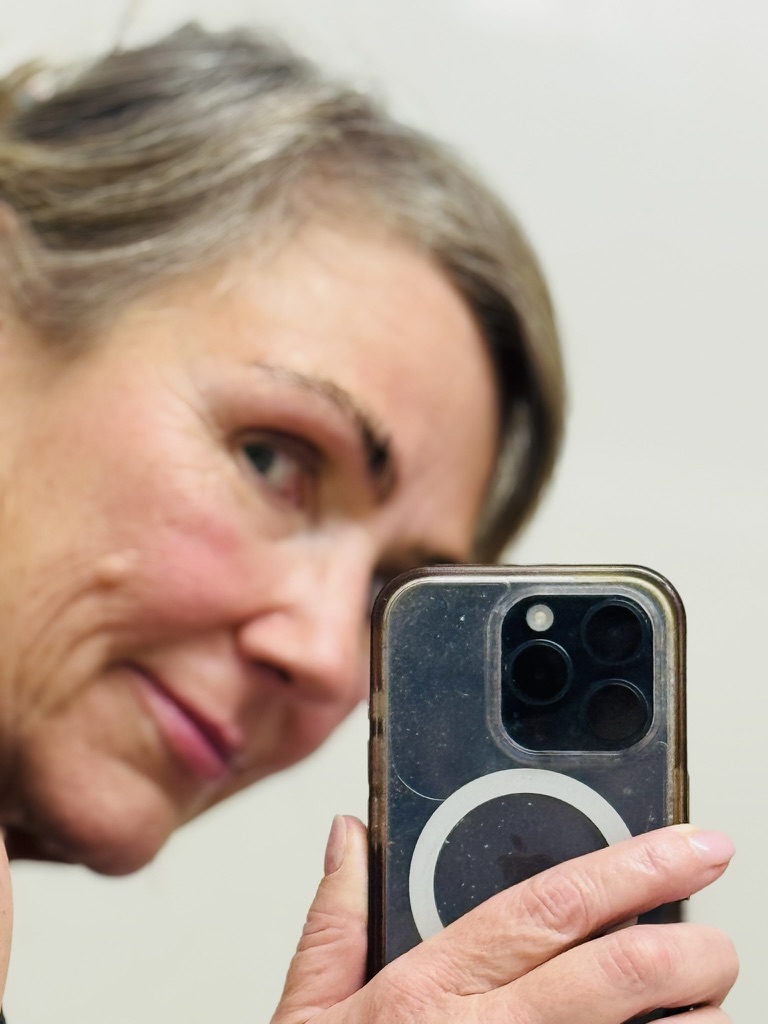
Title: Selfie at the Beginning
Artist Statement

 I nearly skipped this photograph. I have always avoided photographs of myself tired, and I have been tired for years. But Photovoice methodology, developed by Caroline Wang and Mary Ann Burris (1997), insists that the participant is the expert witness of their own experience. If I am going to document this inquiry honestly, I must document myself as I actually am, regardless of how I might wish to appear. This photograph is baseline data. It shows me at the beginning, before I know what thirty days of rest will do. The tiredness in my eyes is evidence. The uncertainty is evidence. The fact that I am here at all, despite everything, is evidence of something still beyond words. Perhaps courage. Perhaps desperation. Perhaps both.

Photo Credit: Amy Tucker, January 2026
Arriving Without an Agenda
I arrived with almost nothing planned. This was deliberate, yet terrifying.
For seventeen years, I have lived by agendas. Syllabi. Course schedules. Committee meetings. Deadline after deadline after deadline. My calendar has been a document of obligations, a record of all the places I needed to be and all the things I needed to produce. Arriving somewhere without a plan feels dangerous to a body trained by precarity to always be preparing for the next demand.
But that is precisely why I chose to come without one.
Transition theorist William Bridges (2019) describes the neutral zone as the disorienting space between an ending and a new beginning. In the neutral zone, the old structures have fallen away, but new ones are still taking shape. Bridges (2019) argues that this space, though uncomfortable, is essential for genuine transformation. If we rush to fill it with busyness and plans, we miss the creative potential it holds.
I am trying to stay in the neutral zone without filling it. I am trying to tolerate the discomfort of holding each day open, uncertain of what it will bring. This is harder than it sounds. My nervous system keeps wanting to make lists, set goals, and measure progress. I keep gently redirecting it back to the present moment.
What do I actually have? Curiosity. Books. A notebook. A camera. Art supplies. My body. Time. The sea.
The sea becomes my research site. I become both subject and observer.
The Body as Research Site
Each day begins quietly. I wake early and watch the light change before the world feels busy. I let my nervous system wake up slowly, which is a practice in itself. For years, I have leapt out of bed with adrenaline already coursing, my mind racing through the day’s obligations before my feet touched the floor. Here, I am practicing a different kind of waking. Gradual. Gentle. Without urgency.
Psychiatrist Bessel van der Kolk (2014) writes that “physical self-awareness is the first step in releasing the tyranny of the past” (p. 101). Physical self-awareness means noticing what is happening in the body: sensations, tensions, areas of ease and discomfort. It sounds simple, but for those of us who have spent years overriding our bodies’ signals, it requires relearning.
I am relearning.
Some mornings I swim, letting the salt water do its steady work on my breath and muscles. The sea holds me, and for once, I release the effort of holding myself. There is something profound about buoyancy, about being supported by something larger than my own effort. I float on my back and watch the sky and feel my shoulders release in ways they never do on land.
Other mornings, I walk along the shoreline, noticing birds, light, and small changes in the tide. I am learning again how to pay attention without trying to control what I see. This is what environmental psychologists Rachel Kaplan and Stephen Kaplan (1989) call “soft fascination”-the effortless attention that natural environments invite. Soft fascination allows directed attention to rest and recover. It is the opposite of the vigilant scanning my nervous system has been doing for years.
“Physical self-awareness is the first step in releasing the tyranny of the past.”
Bessel van der Kolk (2014, p. 101)
Movement as Inquiry
Movement becomes part of the inquiry. But it is a different kind of movement from the one I am used to.
For years, I have been an athlete. Triathlon. Long-distance open-water swimming. I have trained my body to push through discomfort, to ignore fatigue, to override the signals that say stop, slow down, or this is too much. That capacity served me in competition. It also served me in precarious labour, where I pushed through exhaustion semester after semester because stopping felt impossible.
Here, I am practicing a different relationship with movement. Yoga to listen rather than push. Walking without tracking distance or speed. Swimming to settle rather than to train. I am measuring nothing. I am simply moving and noticing what my body tells me.
This is a form of interoception, which I introduced in earlier posts. Interoception is the capacity to sense and interpret signals from inside the body. Neuroscientist Stephen Porges (2011) emphasises that interoception is foundational to well-being. We cannot regulate what we cannot feel. We can only care for ourselves when we know what we need.
My body becomes a source of information instead of something I manage or override. I notice where tension softens. I notice where grief still lives, tucked into my hips and my jaw and the space between my shoulder blades. I notice when joy appears without effort, surprising me with its presence.
“My former life has ended. My new life is still taking shape.”
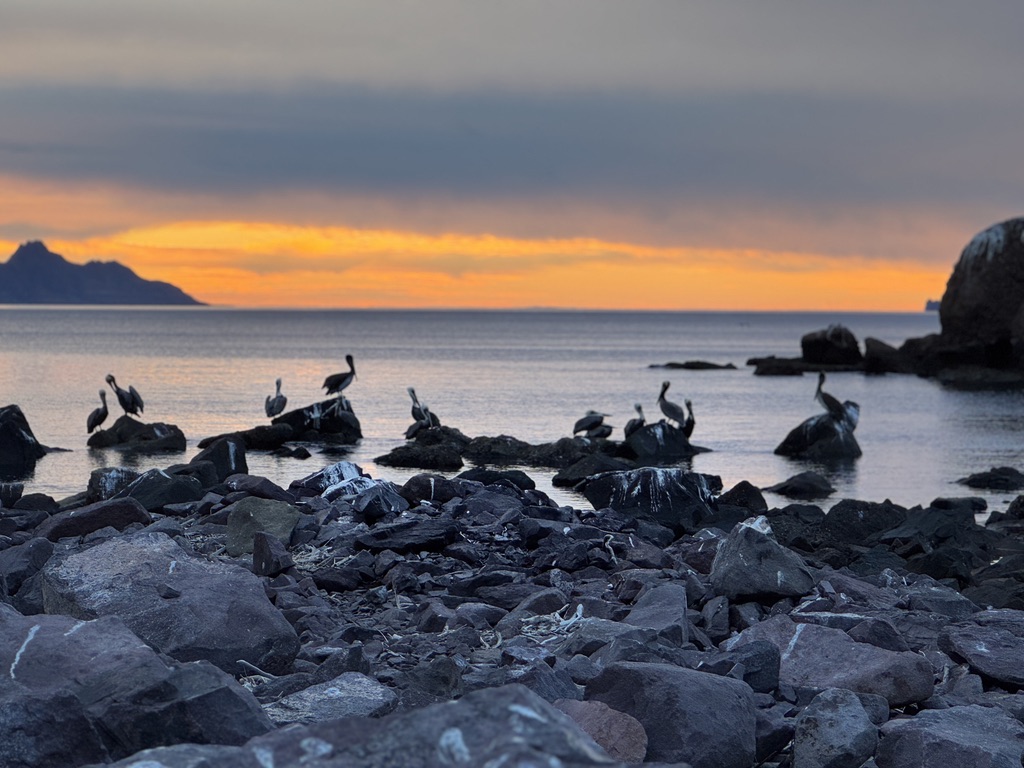
Title: Morning Light on Water
Artist Statement

 I photograph the morning light because it teaches me about presence. This particular quality of light exists only briefly. A moment of inattention and it is gone. There is no way to capture it later or recreate it artificially.

It requires me to be here, now, in this specific moment. Philosopher Donna Haraway (1988) argues that all knowledge is situated, emerging from particular bodies in particular locations at particular times. There is no view from nowhere. There is only the view from somewhere. This photograph is my view from here, from this morning, from this body standing at the edge of this sea. It is partial, specific, and completely true.

Photo Credit: Amy Tucker, January 2026
Art as Companionship
Art weaves its way through the days. Some days I paint or draw. Some days I photograph birds lifting from the water or shadows stretching across the sand. Some days, the art is simply sitting and watching the sea change colour.
This is art therapy without diagnosis, without fixing, without interpretation. It is creation as companionship.
Arts-based research scholar Patricia Leavy (2015) argues that creative practice accesses dimensions of human experience that other methods cannot reach. Art speaks to the aesthetic, the emotional, the sensory, the embodied. It generates knowledge that cannot be reduced to propositions or statistics. When I paint, I am discovering rather than illustrating what I already understand. I am discovering what I know through the act of making.
I brought watercolours with me. They are forgiving, which I need right now. If a mark arrives uninvited, I can let it bleed into something else. I can work with the accident rather than trying to erase it. This feels metaphorically apt. I am learning to work with what has happened to me rather than pretending it never occurred.
These simple materials are an act of resistance against a system that valued me only for what I could produce.
I also brought my camera. Photography, within the Photovoice methodology I am using, functions as a form of witnessing. Wang and Burris (1997) designed Photovoice to enable people to record and reflect on their own experiences. The camera becomes a tool for noticing. It asks, “What do you see?” What matters? What wants to be documented?
The reason for a photograph often arrives later. The image emerges first. The understanding follows, sometimes days afterward. This is part of the methodology. I trust that meaning will arrive in its own time.
Title: Art Supplies
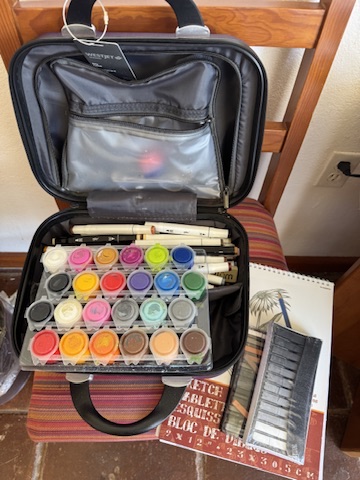
Photo Credit: Amy Tucker, January 2026
Artist Statement

I photographed my art supplies because they represent permission. For years, I abandoned art. I told myself time was absent, which was true. I told myself it was unproductive, which was the language of a system that valued me only for output. These simple materials, watercolours and paper and a few brushes, are an act of resistance against that system. They say: making something for its own sake is enough. Beauty is enough. Play is enough. Moore (1992) argues that caring for the soul is a crafted, patient practice that requires openness to life’s unfolding rather than attempts to control or accelerate it. These supplies are tools for soul care. They ask nothing of me except presence.

Photo Credit: Amy Tucker, January 2026
Silence as Data
Writing happens when it wants to. Sometimes it comes as complete sentences. Sometimes as fragments. Sometimes in silence.
I am learning to permit myself to rest when there are no words. This is difficult for someone who has spent her career producing text: syllabi, assignments, feedback, articles, reports, emails without end. I have been trained to believe that writing equals work equals value. It is a false equation.
Here, I am practicing a different relationship with language. I am practicing trust, both in myself and in the process. I am learning that silence is also data.
Nash (2004) writes that “we do not live in reality itself. We live in stories about reality” (p. 33). The stories I have told about myself, the overworked educator, the reliable colleague, the person who always says yes, have shaped how I experience my life. But stories can be revised. New narratives can emerge. This requires silence, space, and time for the old stories to loosen their grip.
Some days I write pages. Some days I write nothing. Both are part of the inquiry.
“We do not live in reality itself. We live in stories about reality.”
Robert Nash (2004, p. 33)
Evenings and Reflection
I imagine evenings marked by sunsets and reflection. I review the day gently, asking what surfaced and what settled. I resist the rush to make meaning. I let experiences sit, knowing they will braid together in their own time.
This practice draws on what contemplative traditions call discernment, the slow work of noticing patterns and allowing clarity to emerge. It is the opposite of the rapid analysis I have been trained to perform in academic settings, where every observation must be immediately connected to theory, and every experience interpreted and explained.
Here, I am practicing a slower kind of knowing. I am trusting that understanding will come when it is ready. The sea holds my questions without demanding answers.
Donna Haraway’s (1988) concept of situated knowledge provides an important epistemological grounding for this project. Haraway argues that knowledge is always partial, embodied, and located, and that broader understanding emerges from specific positions rather than detached universality. This perspective challenges claims of neutral objectivity, emphasising that what we know is shaped by where we are, who we are, and how we are positioned within power relations.
In this inquiry, Loreto serves as an epistemic site where geography, solitude, and embodiment actively shape knowledge production. By situating this work in a particular body and place, the project embraces partiality as a methodological strength and foregrounds reflexivity, positionality, and relational accountability in the generation of knowledge. I am somewhere particular: Loreto, México, the edge of the Sea of Cortez, this specific body at this specific moment in history. The larger vision I am seeking, whatever it turns out to be, can only emerge from this particular location. There is no shortcut. There is no way to skip the slow work of being here.
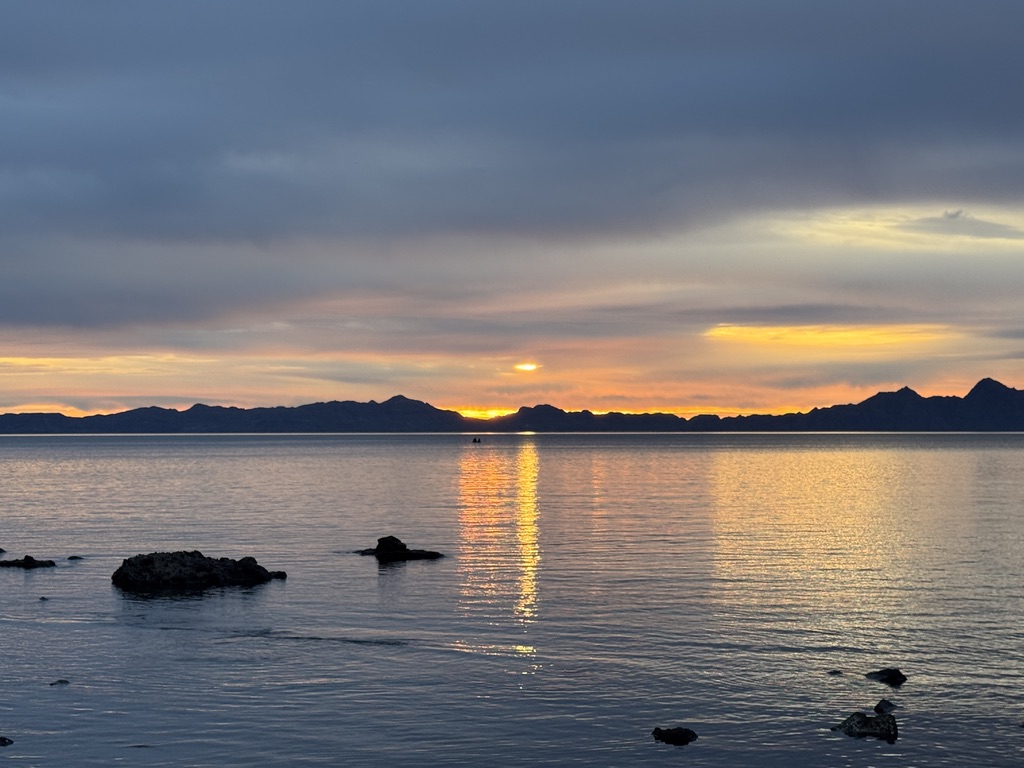
Title: Sunrise
Artist Statement

I photograph sunrises because they mark beginnings without certainty. The day begins, offering itself without promises. Light returns, yet it does so quietly, without spectacle or demand. There is comfort in this daily renewal, in the gentle assurance that illumination follows darkness.

Anthropologist Victor Turner (1969) wrote about liminality as the threshold state between what was and what will be. Sunrise is a liminal time. It belongs neither fully to night nor fully to day. I am drawn to these threshold moments because I am living within one. My former life has ended. My new life is still taking shape. I stand in the early light, attentive to what is emerging, noticing what the morning reveals about who I am becoming.

Photo Credit: Amy Tucker, January 2026
The Human Right to Imagine
I want to pause here and connect what I am doing to the human rights framework that grounds this entire project.
Article 27 of the Universal Declaration of Human Rights (United Nations, 1948) states that “everyone has the right freely to participate in the cultural life of the community, to enjoy the arts and to share in scientific advancement and its benefits.” This right to participate in cultural life, to make and enjoy art, is fundamental to human dignity, beyond luxury.
But precarious labour systematically erodes this right. When every hour must be monetised, when exhaustion is chronic, when the nervous system is trapped in survival mode, there is no space left for creativity. Art becomes something other people do. Imagination becomes a luxury we cannot afford.
This residency is an exercise of my right to participate in cultural life. I am making art. I am writing. I am imagining possibilities beyond survival. These are expressions of human dignity, denied me for too long by years of precarious working conditions.
Van der Kolk (2014) emphasises that trauma recovery requires more than the absence of symptoms. It requires the restoration of imagination, play, and creative engagement with life. Healing is about being able to imagine and pursue a life worth living, beyond feeling less bad.
I am here to recover my imagination.
What I Imagine Finding
What I imagine most clearly is this: that after thirty days, I will return with something quieter and more durable than conclusions, etc.
A steadier body. One that has remembered what rest feels like and can recognise the difference between genuine peace and the numb exhaustion that masquerades as calm.
Clearer boundaries. The capacity to say no without guilt, to protect my time and energy, to refuse demands that diminish my wellbeing.
A renewed relationship with creativity. The knowledge that making art is a way of being in the world, beyond any reward for finished work, that I have a right to claim.
A deeper respect for slow, embodied ways of knowing. The understanding that wisdom arrives through many paths beyond analysis and argument. Sometimes it arrives through the body, through sensation, through the patient’s accumulation of presence.
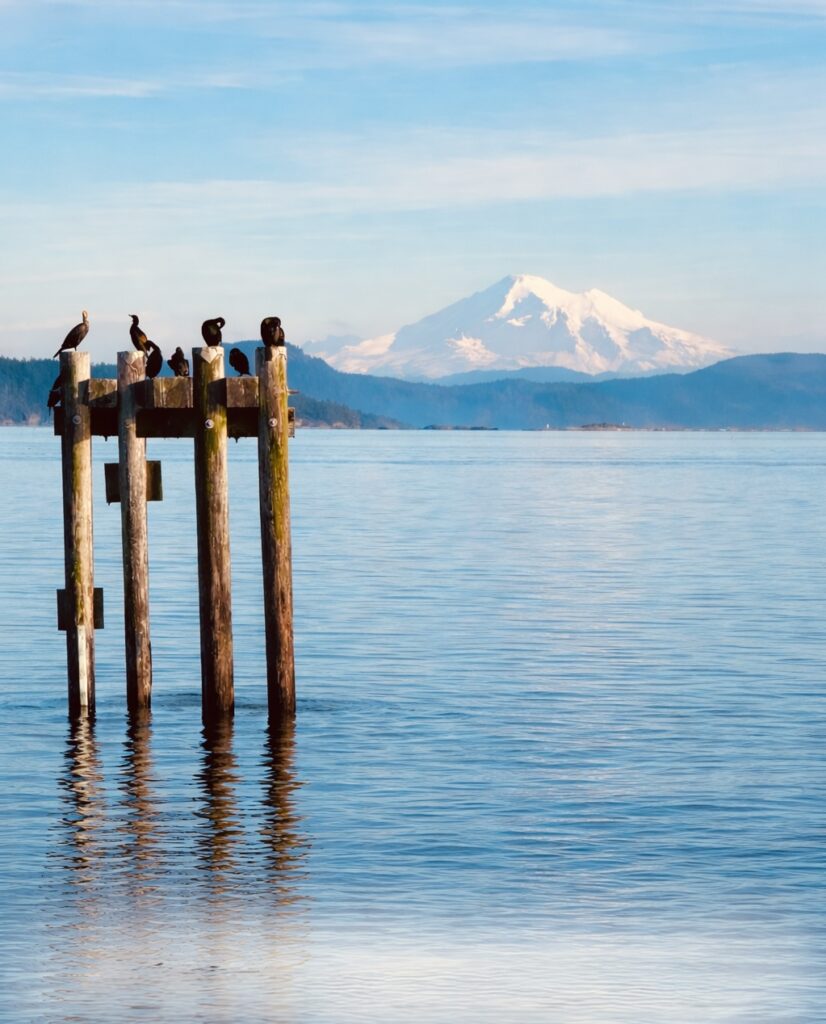
Title: Before the Sea
Artist Statement

I include this photograph from before I left because it reminds me of where I started. This is the coast I know, the cold Pacific waters of British Columbia, where I have lived and worked and struggled for years. The Sea of Cortez, where I am now, is warmer, calmer, different in almost every way.

But I carry the northern waters with me. They are part of my body's memory, part of the archive I am learning to read. Including this image honours the full journey, the arrival and the departure, where I am and where I have been.

Photo Credit: Amy Tucker, 2025
What Remains
This is what I imagine research can look like when it is grounded in care, honours the body, and makes healing a legitimate form of inquiry.
I am producing no outputs, generating no deliverables, optimising nothing. I am simply here, attending to what surfaces, trusting that the inquiry itself is valuable even if I cannot yet articulate what it will yield.
Moore (1992) suggests that caring for the soul involves attentive practice, patience, and an openness to the natural unfolding of life rather than attempts to control or accelerate it. I am practicing that patience. I am cultivating that willingness. I am learning to let life unfold without forcing it into predetermined shapes.
And perhaps that, in itself, is the finding.
The ability to envision a life beyond survival is a human right.
An Invitation
If you are reading this and you have forgotten how to imagine, I want you to know: the capacity is still there. It may be buried under exhaustion, under obligation, under years of being told that dreaming is a luxury you cannot afford. But it is there.
Imagination is a human right. Rest is a human right. The ability to envision a life beyond survival is a human right.
I am here, by the sea, trying to remember what I already know.
Estoy imaginando. Estoy aprendiendo a soñar de nuevo.
I am imagining. I am learning to dream again.
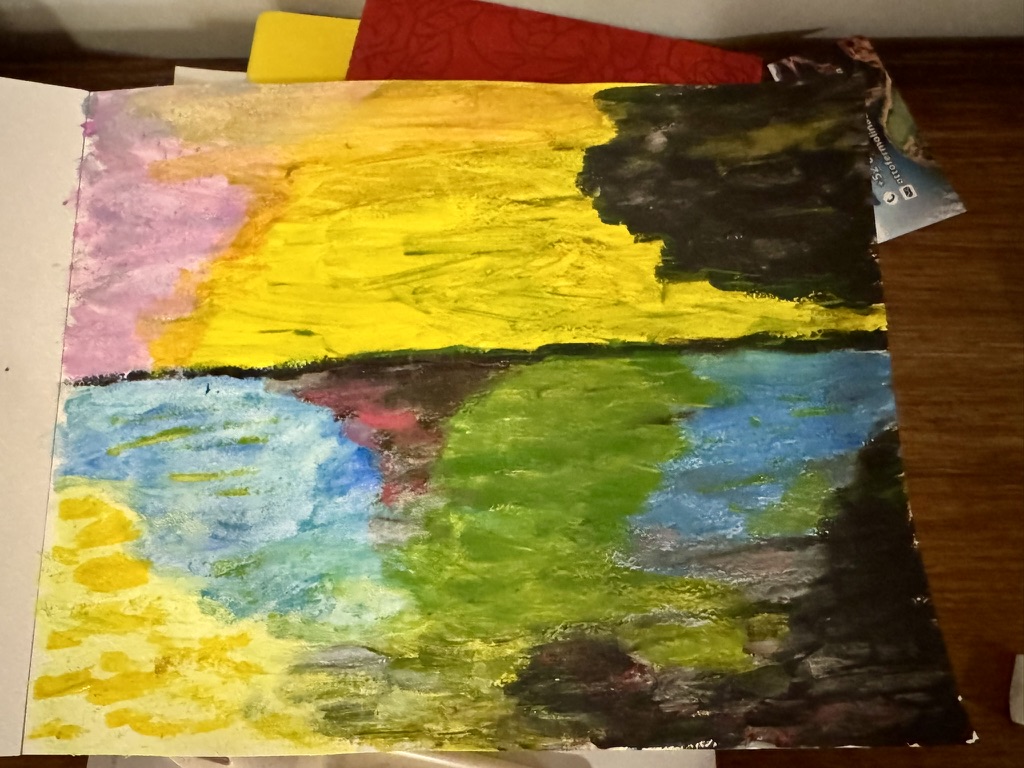
Title: Where the Colours Meet
Artist Statement

This piece began without a plan.

I was sitting with paint, searching for a feeling rather than an image. The yellow came first. Wide. Expansive. Almost insistent. It held the space like light that refuses to dim.

Then water arrived. Blue, then green. Movement over stillness. A shoreline forming without being drawn.

There is a darkness on the right side that I chose to leave unresolved. It felt honest to leave it there. Some things in the landscape simply exist alongside the rest.

Within my creative practice, works like this function as emotional cartographies. They are less about representation and more about locating where I am internally at a given moment in time.

This one sits somewhere between emergence and rest.

Meeting itself.
Between departure and arrival.

Photo Credit: Amy Tucker, 2026
I am here, by the sea, trying to remember what I already know.
Note. Spanish-language passages were generated using Google Translate (Google, n.d.) and subsequently reviewed and refined by the author. Any remaining infelicities reflect the limits of machine translation rather than intent.
References
Bridges, W., & Bridges, S. (2019). Transitions: Making sense of life’s changes (40th anniversary ed.). Balance.
Google. (n.d.). Google Translate. https://translate.google.com
Haraway, D. (1988). Situated knowledges: The science question in feminism and the privilege of partial perspective. Feminist Studies, 14(3), 575–599. https://doi.org/10.2307/3178066
Kaplan, R., & Kaplan, S. (1989). The experience of nature: A psychological perspective. Cambridge University Press.
Leavy, P. (2015). Method meets art: Arts-based research practice (2nd ed.). Guilford Press.
Moore, T. (1992). Care of the soul: A guide for cultivating depth and sacredness in everyday life. HarperCollins.
Nash, R. J. (2004). Liberating scholarly writing: The power of personal narrative. Teachers College Press.
Porges, S. W. (2011). The polyvagal theory: Neurophysiological foundations of emotions, attachment, communication, and self-regulation. W. W. Norton & Company.
Turner, V. (1969). The ritual process: Structure and anti-structure. Aldine Publishing.
United Nations. (1948). Universal declaration of human rights. https://www.un.org/en/about-us/universal-declaration-of-human-rights
van der Kolk, B. A. (2014). The body keeps the score: Brain, mind, and body in the healing of trauma. Viking.
Wang, C., & Burris, M. A. (1997). Photovoice: Concept, methodology, and use for participatory needs assessment. Health Education & Behaviour, 24(3), 369–387. https://doi.org/10.1177/109019819702400309